MailerSend Review 2025: Complete Analysis
MailerSend has emerged as a leading transactional email service provider, offering developers and businesses a powerful platform for sending critical automated emails. This comprehensive review examines MailerSend’s features, pricing, user experience, and how it compares to competitors like Sender, SendGrid, and Postmark in 2025.
What is MailerSend?
MailerSend is a cloud-based transactional email service designed specifically for sending automated, trigger-based emails such as order confirmations, password resets, welcome messages, and shipping notifications. Created by the team behind MailerLite, MailerSend focuses exclusively on transactional messaging rather than email marketing campaigns.
The platform distinguishes itself through its developer-friendly API, intuitive dashboard that enables non-technical team members to contribute, and robust infrastructure built for high deliverability rates. Unlike marketing email platforms, MailerSend specializes in one-to-one automated communications that are triggered by specific user actions or events.
MailerSend integrates quickly into your tech stack, scales with your sendings, and ensures that your emails get delivered, making it suitable for businesses ranging from startups to enterprises handling millions of emails monthly. The service emphasizes reliable email delivery with advanced features like email verification, inbound routing, and comprehensive analytics.
MailerSend Key Features
MailerSend’s approach to email campaigns differs significantly from traditional marketing platforms. The service focuses on transactional email campaigns that are automatically triggered by user behavior or system events. Users can create sophisticated email workflows using the bulk email endpoint, which allows sending up to 500 emails per request.
The platform includes advanced analytics tools for in-depth, custom reporting, and an email activity page to check the status of emails in real-time. This real-time monitoring capability ensures that critical business communications reach recipients promptly. The system handles variable email volumes efficiently, scaling from a few emails to millions without performance degradation.
Campaign management features include email split testing, suppression list management, and detailed delivery tracking. Users can organize campaigns using tags and filters, making it easier to analyze performance across different types of transactional emails.
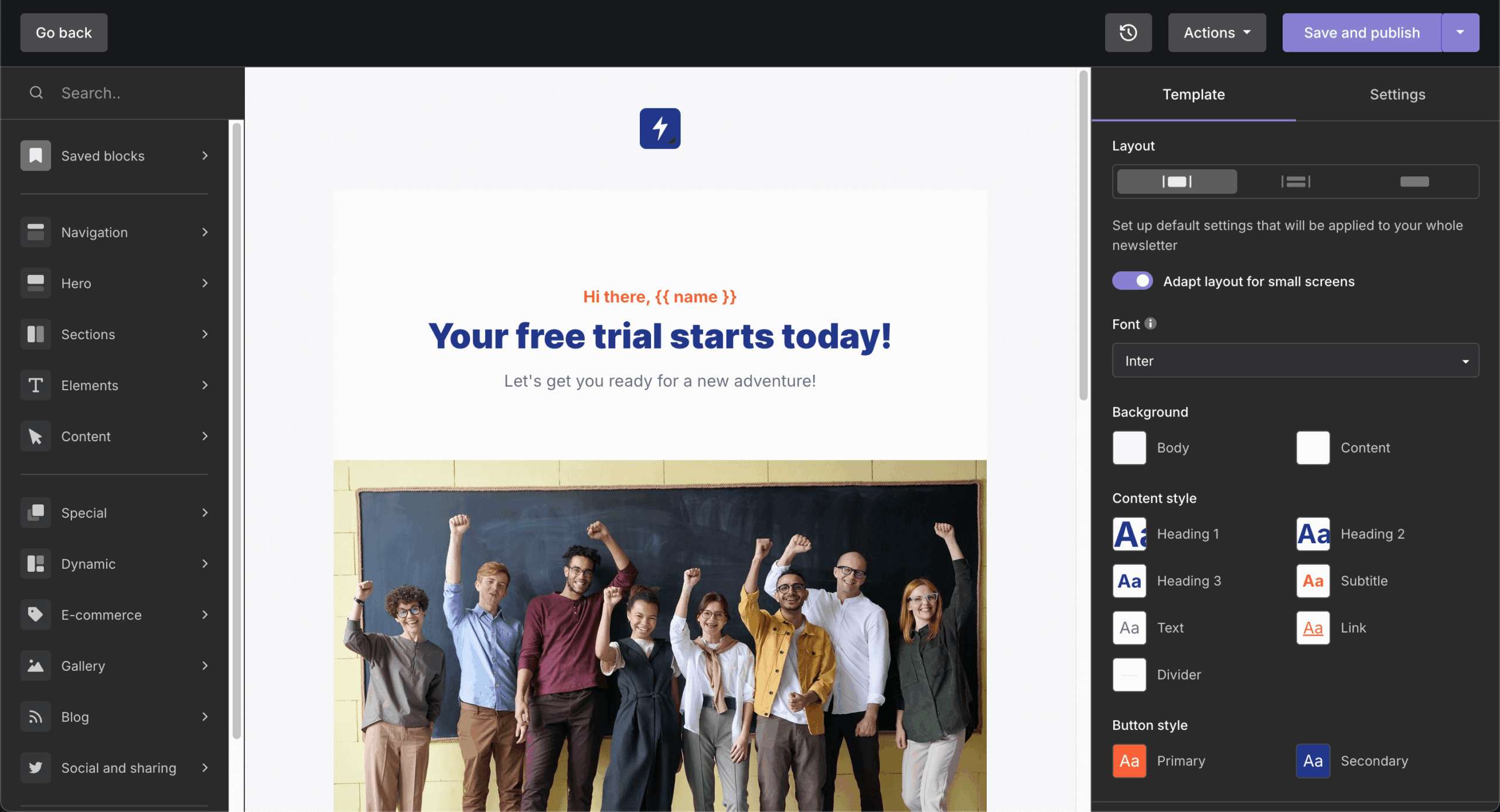
MailerSend offers three distinct template creation methods to accommodate different skill levels and requirements. The drag-and-drop builder features over 90 pre-built content blocks, enabling non-technical users to create professional emails quickly. The HTML template editor provides advanced customization options for developers who prefer coding their templates.
Dynamic email templates allow users to create personalized messages at scale, using variables, filters, conditional logic, and dynamic tables. This functionality is crucial for ecommerce businesses needing to generate order confirmations with product details or SaaS companies sending personalized account notifications.
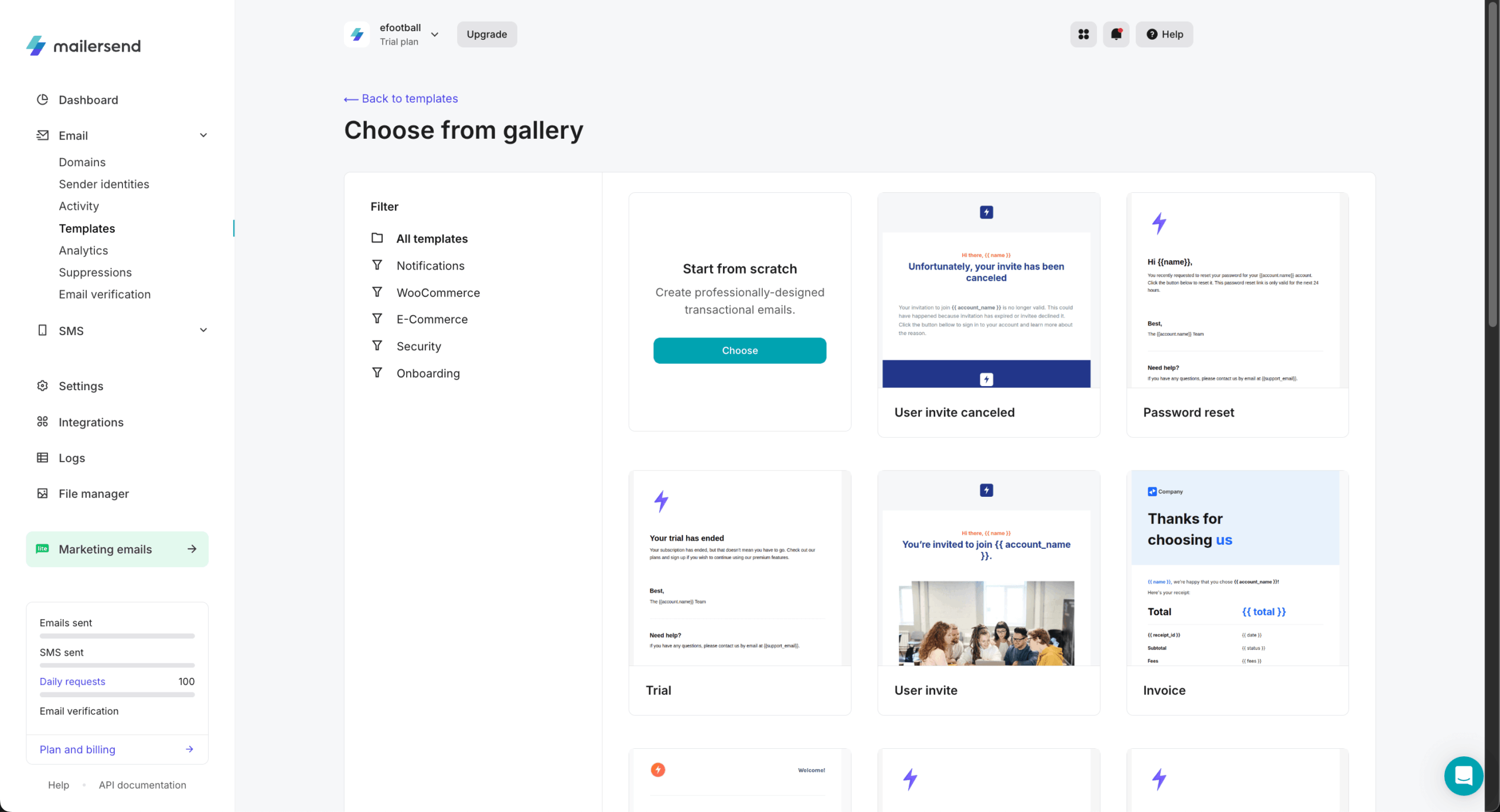
The platform includes a rich gallery of professionally designed templates covering various transactional email categories including onboarding, security, ecommerce, and notifications. Templates are fully responsive and optimized for different email clients, ensuring consistent rendering across devices.
MailerSend’s automation capabilities center around webhook-driven workflows and API-based triggers rather than traditional marketing automation. The platform supports real-time webhooks that notify your application of email events, enabling automatic reactions to delivery status, opens, clicks, and bounces.
Users can configure webhooks to receive instant push updates by listening for email events rather than waiting for API polling to complete. This real-time communication enables sophisticated workflows, such as automatically flagging failed deliveries or triggering follow-up actions based on recipient engagement.
The automation system includes conditional logic within templates, allowing dynamic content display based on recipient data. However, unlike marketing platforms, MailerSend doesn’t offer visual workflow builders or complex multi-step automation sequences, focusing instead on reliable, trigger-based messaging.
MailerSend approaches subscriber management differently from marketing platforms, focusing on recipient verification and suppression list management rather than traditional list building. The platform includes built-in email verification tools that can validate individual addresses or process bulk lists to maintain deliverability.
The email validation API helps clean recipient lists and optimize web forms to validate emails at the point of collection. This proactive approach prevents sending to invalid addresses, protecting sender reputation and improving delivery rates.
Suppression management features automatically handle unsubscribes, bounces, and spam complaints. Users can manage multiple suppression lists across different domains and projects, ensuring compliance with email regulations while maintaining clean recipient databases.
Unlike traditional email marketing platforms, MailerSend does not include landing page or form creation tools. The service is designed specifically for transactional email delivery, assuming that forms and landing pages are managed through other platforms or custom applications.
However, MailerSend integrates seamlessly with external form builders and landing page tools through its flexible API and webhook system. When users submit forms on external platforms, those systems can trigger MailerSend to send confirmation emails, welcome messages, or other transactional communications.
For businesses needing comprehensive form and landing page functionality, MailerSend pairs well with platforms like MailerLite (for marketing forms) or custom web applications that handle user interactions and trigger appropriate transactional emails.
MailerSend provides comprehensive email analytics focused on delivery performance and recipient engagement. The analytics dashboard displays key metrics including delivery rates, open rates, click-through rates, bounce rates, and spam complaints, with data available for up to 45 days by default.
Users can access key metrics such as opens, clicks, bounces, unsubscribes, and more in the analytics dashboard, with the ability to filter data for accounts, domains, or individual email templates and create custom reports. The platform offers both visual charts and detailed data exports for deeper analysis.
Advanced reporting features include geographical data showing where emails are opened, device and email client information, and reading environment analysis. Real-time activity feeds provide immediate visibility into email status, making troubleshooting and optimization straightforward.

MailerSend offers a robust API with official SDKs for popular programming languages including PHP, Python, Node.js, Ruby, Java, Go, and .NET. The API documentation is comprehensive, enabling developers to integrate email functionality quickly and reliably.
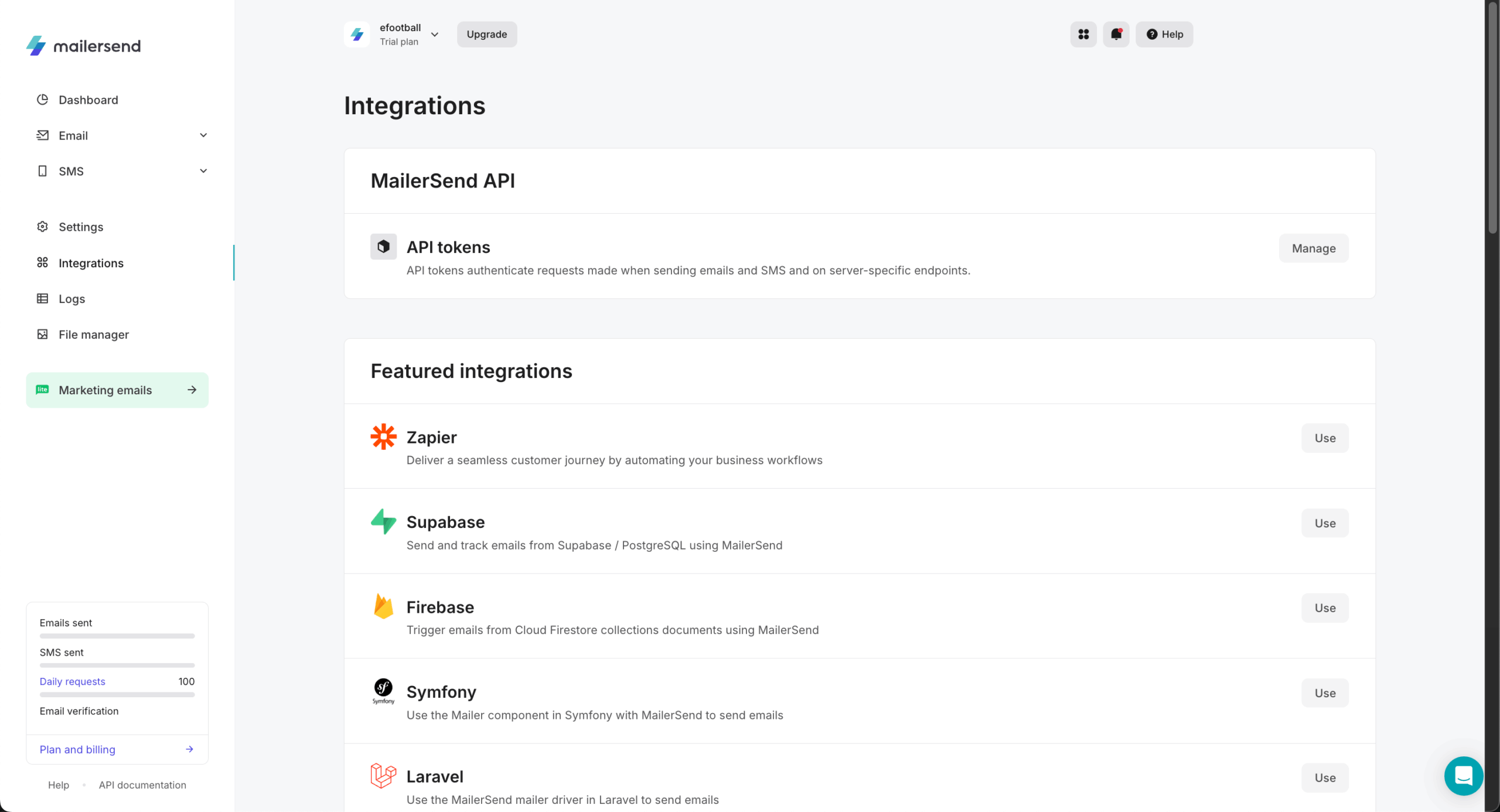
The platform provides flexible API endpoints for domain management, template creation, recipient verification, and sending configuration. Additional integrations include Zapier connectivity for connecting with over 4,000 applications, making it accessible to non-technical users.
SMTP relay options provide plug-and-play functionality for applications that prefer SMTP over API integration. The platform supports multiple domains per account, enabling businesses to manage different brands or environments from a single dashboard.
MailerSend provides 24/7 customer support through multiple channels including live chat, email, and comprehensive documentation. User reviews consistently praise the support team’s responsiveness and technical expertise, with many noting that responses are fast and the team proactively thinks along with customers.
The support approach focuses on technical assistance rather than general inquiries, with team members equipped to help with API integration, deliverability optimization, and advanced configuration. The platform includes extensive developer documentation, video tutorials, and a knowledge base covering common implementation scenarios.
Users on all plans receive the same level of support without tiered restrictions, ensuring that even free plan users can access technical assistance when needed.
MailerSend excels as a dedicated transactional email service, offering both robust API and SMTP relay options for seamless integration.
The platform’s transactional email API enables developers to send automated messages, while the email verification tool validates addresses before sending to maintain deliverability. MailerSend provides extensive transactional email templates customizable using dynamic variables for personalized content.
Unlike transactional vs marketing emails platforms attempting both, MailerSend focuses exclusively on reliable transactional email delivery. The service includes inbound routing for processing replies, suppression management for automatic bounce handling, and webhooks for real-time notifications.
MailerSend’s detailed analytics dashboard displays delivery rates, opens, and clicks specifically for transactional emails, establishing it as a premier transactional email provider and email deliverability service.
MailerSend Pricing Plans and Value
Plan
Monthly Price
Emails Included
Key Features
Trial
Free
100 emails
Trial domain, basic features
Hobby
Free
3,000 emails
All core features, $1 per 1K additional emails
Starter
From $28/month
50,000 emails
Multiple domains, templates, webhooks, 30-day logs
Professional
From $88/month
50,000 emails
Advanced features, live chat support, unlimited users
MailerSend offers transparent pricing with all plans providing access to core email delivery features, with higher tiers adding operational capabilities like multiple domains and extended log retention. The free tier provides 3,000 emails monthly, making it suitable for small applications and testing purposes.
Pricing scales based on volume, with additional emails charged at decreasing rates as usage increases. Annual plans offer 20% savings over monthly billing, and nonprofit organizations receive a 30% discount on paid plans.
MailerSend Pros and Cons
- Excellent deliverability rates
- Developer-friendly API and documentation
- Generous free tier (3,000 emails)
- 24/7 technical support
- Real-time analytics and webhooks
- User-friendly interface for non-technical users
- Limited to transactional emails only
- No visual automation workflows
- Approval process required for new accounts
- No built-in landing pages or forms
- Pricing can increase significantly at scale
- Limited marketing email capabilities
MailerSend Pros
MailerSend excels in deliverability and technical implementation. Users consistently report excellent deliverability rates, with many noting that emails arrive promptly and reliably reach inboxes rather than spam folders. The platform’s focus on transactional emails means it maintains strong sender reputation and relationships with ISPs.
The developer experience stands out as a major advantage, with comprehensive API documentation, multiple SDKs, and quick integration times. Many users report being able to integrate and start sending emails within minutes or hours, significantly faster than competitors.
Customer support quality receives exceptional praise, with users highlighting the technical expertise and responsiveness of the support team. Unlike many competitors that offer tiered support, MailerSend provides consistent assistance across all plan levels.
MailerSend Cons
Limited scope represents the primary limitation, as MailerSend focuses exclusively on transactional emails without marketing campaign capabilities. Businesses needing comprehensive email marketing must use additional tools, though integration with MailerLite provides a solution for existing users.
Account approval requirements can create barriers for new users. Some users report having accounts suspended or rejected without detailed explanations, though MailerSend states this process helps maintain deliverability standards for all users.
Scaling costs can become significant for high-volume users, with some reviews noting that pricing becomes less competitive above 20,000 emails monthly compared to enterprise-focused competitors.

Should You Choose MailerSend?
Best For ✅
Not Recommended For ❌
SaaS applications needing reliable transactional emails
Businesses primarily focused on email marketing
Developers requiring robust API integration
Users wanting visual automation workflows
Teams needing collaborative email management
Companies needing built-in landing pages
Businesses prioritizing deliverability
Organizations on extremely tight budgets at scale
Applications requiring real-time email tracking
Users preferring all-in-one marketing platforms
Who MailerSend is Perfect For
MailerSend is ideal for developers and businesses that prioritize reliable transactional email delivery. SaaS companies, ecommerce platforms, and web applications benefit most from its technical capabilities and deliverability focus. The platform suits teams where both technical and non-technical members need to contribute to email creation and management.
Startups and growing businesses find value in the generous free tier and transparent scaling model. The platform accommodates rapid growth without requiring significant architectural changes, making it suitable for companies expecting to scale their email volume significantly.
Organizations prioritizing deliverability over marketing features should consider MailerSend, especially those that have experienced deliverability issues with other providers. The platform’s focus on transactional emails typically results in higher inbox placement rates.
Who Should Consider an Alternative
Businesses needing comprehensive email marketing capabilities should look elsewhere, as MailerSend doesn’t provide campaign building, list management, or marketing automation features. Companies requiring visual workflow builders or complex automation sequences may find the platform limiting.
Very high-volume senders (over 500,000 emails monthly) might find more cost-effective solutions with enterprise-focused providers like SendGrid, Amazon SES, and other Amazon SES alternatives. Small businesses primarily focused on newsletters would benefit more from dedicated marketing platforms like Sender.net or Mailchimp.
MailerSend User Experience and Reputation

G2 users consistently praise MailerSend’s reliability and generous free tier. Reviews highlight the platform’s excellent deliverability rates and straightforward integration process, with many users noting the generous free plan and pay-as-you-go model. Technical users appreciate the clean API documentation and quick setup times.
Common positive themes include superior deliverability compared to competitors, responsive customer support, and developer-friendly implementation. Some users note concerns about pricing increases and the transition from the original 12,000 email free tier to the current 3,000 email limit.
Capterra reviews emphasize MailerSend’s technical capabilities and support quality. Users frequently compare MailerSend favorably to SendGrid and other competitors, particularly regarding deliverability and customer service responsiveness. Many reviews highlight successful migrations from other platforms due to delivery issues.
Negative reviews primarily focus on account approval processes and pricing concerns. Some users report frustration with account suspensions and limited communication about approval criteria, though MailerSend representatives actively respond to reviews to address concerns.
Trustpilot users highlight MailerSend’s reliability and ease of use. Reviews consistently mention fast setup times, excellent deliverability, and responsive technical support, with many users noting successful resolution of complex integration challenges. The platform receives particular praise for its clean interface and comprehensive documentation.
Support responsiveness emerges as a key theme, with users appreciating detailed technical assistance and proactive problem-solving. Most negative reviews relate to specific technical configurations or account setup issues rather than fundamental platform problems.
MailerSend Alternatives
MailerSend, from the team behind MailerLite, is a developer-friendly service for transactional email and SMS, with templates, inbound routing and simple volume-based pricing. But its free plan now covers just 500 emails a month with one domain and one template, SMS is limited to the US and Canada, Starter plans keep only 7 days of activity data, and it isn’t built for marketing campaigns. The first three alternatives below replace MailerSend for transactional sending, and the last two cover marketing.
SendGrid: best for enterprise-scale sending
SendGrid makes sense if you’re sending at serious volume and want a long-established infrastructure provider. Owned by Twilio, it offers a mature API, SMTP relay and a separate marketing campaigns product, with deliverability tools and dedicated IPs as you grow. The trade-off is that there’s no permanent free plan, only a 60-day trial at 100 emails a day, and its most advanced features sit on its higher-priced plans. Read our full SendGrid review.
Postmark: best for reliable transactional delivery
Postmark is the one to pick if inbox placement for receipts, password resets and notifications matters most. It sends transactional and broadcast email through separate streams on different IP pools, so marketing sends can’t hurt your transactional reputation, and it keeps 45 days of message history, compared with 7 days on MailerSend’s Starter plan. The trade-off is that it costs more per email than MailerSend at higher volumes, its free tier covers only 100 emails a month, and it has no SMS. Read our full Postmark review.
Mailgun: best for developer-focused infrastructure
Mailgun suits development teams that want flexible sending infrastructure with more room on the free plan. Its free plan includes 100 emails a day, roughly six times MailerSend’s monthly allowance, and it adds email validation, detailed logs and inbound routing. The trade-off is that template tools start on its Foundation plan, dedicated IPs cost extra, and it doesn’t offer SMS. Read our full Mailgun review.
Brevo: best for marketing and transactional email in one place
Brevo makes sense if you need both transactional emails and marketing campaigns without running two tools. It combines transactional email, campaigns, SMS, WhatsApp and a basic CRM, and its free plan sends up to 300 emails a day while storing up to 100,000 contacts. The trade-off is that the free plan’s daily cap limits larger sends, automation and A/B testing require its Standard plan, and Brevo branding stays on free and Starter emails. Read our full Brevo review.
Sender: best for marketing campaigns
Sender suits businesses that mainly use MailerSend for newsletters or promotional emails, which it isn’t designed for. Its free plan covers 2,500 subscribers and 15,000 emails a month with automation, segmentation and landing pages included, SMS is available on paid plans, and it also handles transactional emails. The trade-off is that Sender isn’t built for high-volume API sending or developer-heavy workflows, so apps sending large volumes of transactional mail may still want a dedicated service. Read our full Sender review.
Which alternative should you choose?
Pick based on what’s pushing you away from MailerSend:
- Need enterprise-scale sending: SendGrid
- Want the most reliable transactional delivery: Postmark
- Want a bigger free plan for developers: Mailgun
- Need marketing and transactional email together: Brevo
- Mainly send marketing campaigns: Sender
MailerSend: Worth It or Not?
MailerSend stands out as an excellent choice for businesses prioritizing reliable transactional email delivery with team-friendly collaboration tools. The platform successfully bridges the gap between developer-focused services and user-friendly interfaces, making it accessible to technical and non-technical team members alike.
The service excels in deliverability, API quality, and customer support, consistently outperforming competitors in user satisfaction metrics. The generous free tier and transparent pricing make it attractive for startups and growing businesses, while the robust infrastructure supports enterprise-scale email volumes.
However, MailerSend’s focus on transactional emails means it’s not suitable for businesses needing comprehensive marketing capabilities. Companies requiring landing pages, visual automation workflows, or advanced marketing features should consider complementing MailerSend with dedicated marketing platforms or choosing all-in-one alternatives.
For developers building applications that require reliable email delivery, MailerSend represents one of the best value propositions in the transactional email space. The combination of technical capabilities, user-friendly interfaces, and responsive support creates a platform that scales effectively with growing businesses while maintaining the deliverability standards critical for transactional communications.
Who's behind these reviews?

- Hands-on testing across multiple email marketing tools
- Fair comparisons using a unified evaluation process
- Insights verified with real user reviews from trusted sources
- No sponsorships or affiliate ties
- Clear, unbiased scoring and methodology